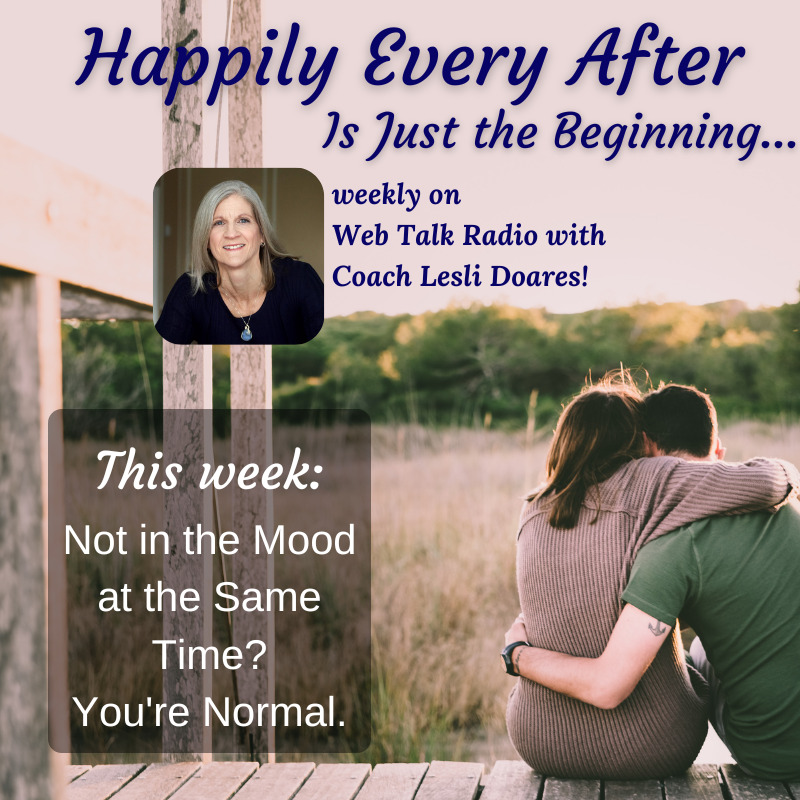

I have said for years that the biggest challenge to a successful marriage is that you are now, always have been, and always will be two different people. And this includes how you approach sex and intimacy. In the beginning of your relationship, this part may have been fairly easy. That’s due to the neurochemicals associated with being in love.
But over time, as these chemicals slowly fade away, intimacy can become more complicated. You each revert back to your “normal” way of experiencing desire. There are basically three different ways this happens:
- Spontaneous – desire shows up instantly without any need for physical stimulation. Just thinking about sex gets you going.
- Responsive – desire shows up in response to physical, emotional and/or mental stimulation.
- Contextual – the ability to feel desire is impacted by circumstances and environment.
Sex educator and author Emily Nagoski, PhD notes that 75% of men and 15% of women experience spontaneous desire. 5% of men and 35% of women experience responsive desire. And that the remaining percentages experience a combination of responsive and contextual desire.

Is “Weaponized Incompetence” Part of Your Marriage?
Weaponized incompetence, also known as strategic incompetence, is pretending to be incapable or inadequate at a task so that someone else will do it for you. However good it may make you feel in the moment to avoid something you don’t want to do; it will cause...

Will Your Marriage Survive the Holidays?
Labor Day is over. School is back in session. Halloween is around the corner and the holidays are bearing down. Is your marriage in a strong enough place to weather all of this? Or will you be one of the many couples calling divorce attorneys in the new year? For the...

Should You Be More Honest About the State of Your Marriage?
You’ve probably heard the expression “honesty is the best policy”. You may even claim that honesty is one of your core values. But when it comes to your marriage, do you follow through? If not, why not? Two things have happened this week that have this front and...
But like most things, we tend to act as if others feel and behave the way we do. Applying this to your desire can really complicate your intimate life.
As I talked about last time, the context of your intimate encounter matters. If you are short on time or one of you is distracted, the chance of mutual satisfaction goes down. And women often seem to be impacted by context. And it often starts long before you head to the bedroom.
And this is where mental/emotional load comes in. If your wife is overloaded with managing more of the daily family activities, her context may not be conducive to intimacy.
In addition, if the two of you don’t spend intentional quality time together outside the bedroom, her contextual desire, again, may be lacking. And this is where many marriages have room for improvement.
When things cool down in the bedroom there can be a tendency to keep the focus there. You find advice to try different positions, introduce toys, role playing, etc. But if the problem is one of context or disconnection, none of those things will help. In fact, it can actually backfire.
Focusing on physical intimacy when the issue is emotional intimacy can put extra pressure on you both, not what you want if contextual desire is at play,
If you really want to increase your intimacy and connection, what goes on outside of the bedroom needs to support what you want in the bedroom. It won’t change how you each feel desire, you’ll still have to navigate that, but it will give you a head start.
Ready to get started? Schedule your 5 Star Relationship Call with me today.
Around the Web This Week